
News story
23 September 2026
A portable backpack for young cancer patients to allow them to spend less time in hospital and more time at home with family and pioneering infrared scanners that are improving the five-year survival rates in cancer patients by up to 28% are just some of the many projects being funded by supporters of Addenbrooke’s Charitable Trust (ACT).
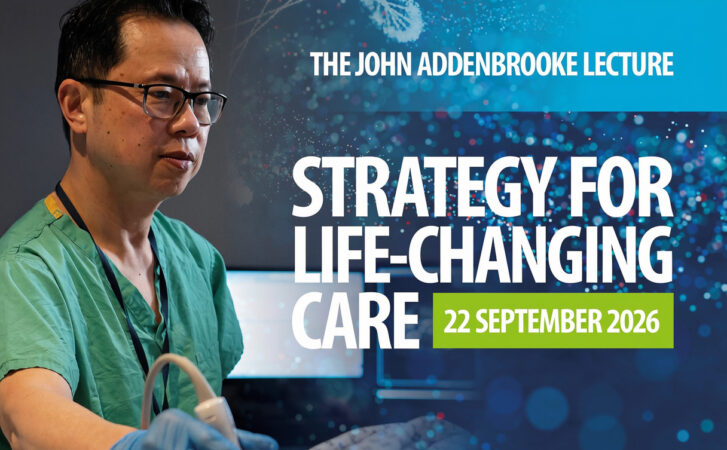
Last night’s annual John Addenbrooke Lecture, following the theme Strategy for Life-Changing Care, brought medical experts, clinical staff and ACT donors and supporters together under one roof to hear how funding from the charity is having a huge impact on patient care and outcomes.
As the official hospital charity for Addenbrooke’s and the Rosie, ACT funds cutting-edge equipment, specialist staff, extra comforts and vital research above and beyond what the NHS can provide alone.
Last night’s lecture, held at AstraZeneca’s eye-catching Disc building on the Cambridge Biomedical Campus, began with a welcome from ACT’s Chief Executive Shelly Thake.
Addressing the special relationship between ACT and the hospitals was Nicola Ayton, Chief Executive of Cambridge University Hospitals NHS Foundation Trust (CUH) which governs Addenbrooke’s and the Rosie as well as Chief Nurse Lorraine Szeremeta.


Leading experts on the night included Consultant Paediatric Oncologist Jonathan Abrams, known within his field for pioneering efforts in the UK and around the world to introduce a treatment for young cancer patients which can help protect their hearing whilst receiving cancer treatment.

Jonathan, who is based at Addenbrooke’s, spoke about plans to introduce a special backpack for young cancer patients which would allow them to have part of their treatment at home.
The backpack – which if introduced at Addenbrooke’s would be a first for the East of England – is to feature as ACT’s Christmas Campaign this year – with supporters of the charity being asked to help fund a trial of the alternative home treatment which will mean young cancer patients will be able to spend more time with loved ones over Christmas and throughout the year.
Currently children receiving chemotherapy at Addenbrooke’s are admitted as inpatients. Following their treatment, patients need to stay in overnight to have a fluid infusion to wash out the toxins in their system so that the chemotherapy can be repeated the following day.
Whilst the chemotherapy has to be administered in a clinical setting, the fluid infusion does not. By providing families with a special CADD backpack – effectively a fluid pump – and some training, families can return home each day and complete the toxin flush at home.

Guests at the event heard from Isabelle, a young cancer patient with osteosarcoma. Isabelle and her mum talked passionately about what it would have meant for them had they been able to benefit from this new ambulatory service, and what it would mean for future patients to be able to spend as many as 70 extra nights at home in their own beds, rather than in hospital.
Addenbrooke’s award winning Histopathology department, which looks at the study and examination of diseased tissue, was also represented, with a presentation from Jim Neal and Refaie Rassool.

Jim, an Advanced Practitioner in breast dissection and Refaie, an Advanced Practitioner and reporting scientist in gastrointestinal pathology, spoke about the huge impact that two lymph node scanners, funded by supporters of ACT, were having on cancer patients – not just in Addenbrooke’s but across the country – with tissue samples sent to the department from across the UK.
Lymph nodes are used to help diagnose cancer and to determine the best treatment plan for patients. Prior to having the two scanners, practitioners would look for lymph nodes manually. However, lymph nodes are traditionally hard to find and are often lost within fat and tissue, making it difficult for practitioners to collect sufficient numbers for accurate diagnosis.
However, using an infrared light, the scanners locate the lymph nodes instantly – saving the need for further biopsies if the first yield is insufficient.
This more thorough examination of lymph nodes leads to more accurate cancer staging and provides clinicians with clearer diagnostic information to help guide decisions on patient treatment.
The impact of the scanners – used across Breast, Head and Neck, and Gastrointestinal cancer services – is huge: improving the five-year survival rates in cancer patients by up to 28%.
Histopathology received national recognition at this year’s Institute of Biomedical Science Awards (IBMS) earlier this year – winning the Best Use of Innovation category, contributing to the department being named Biomedical Science Champion for its impact on patient care.
Paul White, Director of Communications and Impact at ACT, said supporters of the charity are helping CUH deliver its key strategies – allowing the trust to harness research and improve patient outcomes and giving patients access to earlier, more personal and more convenient support in their communities, aided by digital tools and stronger partnerships.
“Last night’s event was an outstanding demonstration of how, together with supporters, researchers and clinicians, Addenbrooke’s Charitable Trust is pushing what’s possible for patients and staff at our hospitals in so many ways,” he said.
“From transforming the way in which we diagnose cancers using pioneering infrared scanners, reducing anxiety and creating calm by transforming the spaces where patients and staff spend time, to helping children spend more time at home with their families thanks to a simple backpack. All of the projects guests heard about at the event share two things in common.
“Firstly, they make a significant and lasting impact on the care and experience of patients. Secondly, they are devised by staff in the hospital who have a relentless drive to push what’s possible for their patients, and to make sure that every experience they have is the best it can be. We’re proud that together with our supporters we’re able to make these ideas a reality. The evening left us in no doubt of the difference the charity and its supporters can make in helping the hospital to do more than it can achieve alone.”
Claire Billing, ACT’s Director of Fundraising, said: “Every breakthrough we celebrate has been made possible because of people who believe in continuing to push what we are able to do for patients and staff, above and beyond what the NHS is able to do alone.
“As a charity, we are privileged to see first-hand how these investments are transforming lives. This evening is our chance to thank everyone who makes that possible and to show the real-world impact of their support. Together, they are helping to turn pioneering ideas into better care, better outcomes, and brighter futures for patients and their loved ones.”
To help us to continue to make a difference, donate.
Return to news